

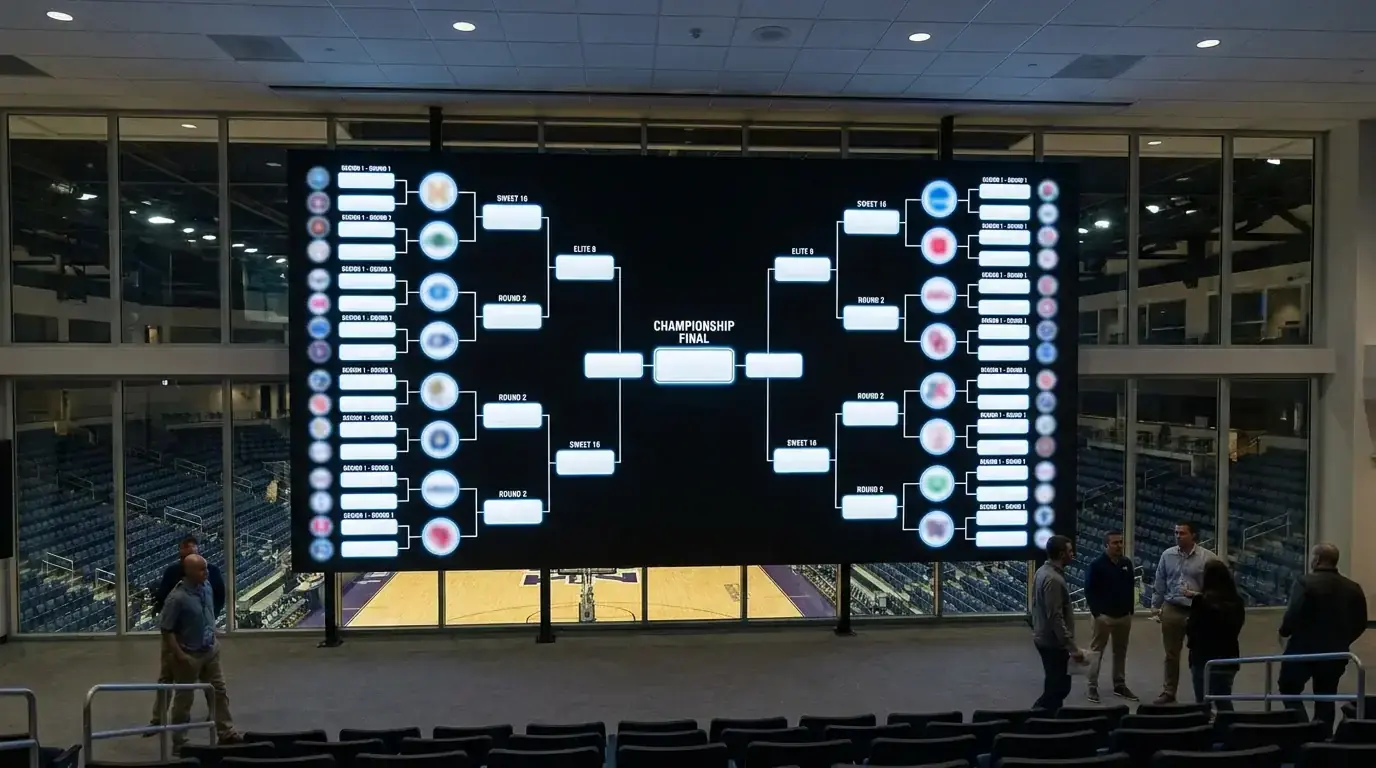
My office bracket pool went sideways within 48 hours of the tournament starting. Top seeds falling to double-digit underdogs, buzzer-beaters erasing supposedly safe leads, complete chaos across every region. March Madness earned its name through decades of exactly this unpredictability – and UK bettors increasingly want access to the action.
The NCAA Tournament brings college basketball to global attention every March, offering UK punters betting opportunities distinct from the NBA markets most know well. Understanding how this single-elimination tournament works and how college basketball differs from the professional game helps navigate March Madness betting effectively.
NCAA Tournament Betting Bracket Structures
Sixty-eight teams qualify for March Madness through conference championship wins or at-large selection committee invitations. The tournament uses single-elimination format – lose once and your season ends immediately. That win-or-go-home pressure creates the volatility that makes March Madness both exciting and unpredictable.
Teams receive seeding from 1 to 16 within four regional brackets. Top seeds face the lowest seeds in opening rounds, theoretically creating easier paths for elite programs. History proves that upsets happen regularly regardless of seeding, with double-digit seeds advancing past favoured opponents nearly every tournament.
The tournament progresses through rounds with distinctive names – First Four, First Round, Second Round, Sweet Sixteen, Elite Eight, Final Four, and Championship Game. Each round eliminates half the remaining field until two teams meet for the national title in early April.
Games occur across multiple venues simultaneously during opening rounds, creating wall-to-wall basketball coverage over long weekends. UK timing makes watching challenging with most games occurring evening through early morning British time, but betting markets remain accessible around the clock.
Betting on March Madness from the UK
Major UK bookmakers offer comprehensive March Madness markets during tournament season. Spreads, moneylines, totals, and various props appear for every game once brackets are announced. The market depth rivals what you would find for major NBA playoff games.
With 10% of the UK population actively participating in online sports betting, demand for American sporting events has grown substantially. Bookmakers responded by expanding college basketball coverage during March Madness, recognising the tournament’s global appeal and betting potential.
Futures markets let you bet tournament winner, Final Four participants, and regional champions before games begin. These long-shot wagers carry high variance but offer significant returns when identifying dark horse contenders the market undervalues.
Live betting availability varies by game and bookmaker. High-profile matchups typically feature robust in-play markets while early-round games between lower seeds might offer limited live options. Check your preferred bookmaker’s coverage before relying on in-play strategies.
Bracket Pool Betting Strategies
Bracket pools ask participants to predict every tournament game outcome before the first tip-off. Points accumulate based on correct picks, with later rounds typically worth more than early rounds. Millions participate in bracket pools ranging from office competitions to massive online contests with significant prizes.
Contrarian thinking often wins bracket pools. When everyone picks the same favourites, differentiating your bracket requires identifying upsets others miss. One well-chosen upset that eliminates a popular pick can vault you past competitors who followed consensus.
The UK sports betting market has grown with a projected CAGR of 11.4% through 2030, and March Madness contributes to that growth as more British bettors discover tournament excitement. Bracket pools offer low-stakes entry points for those exploring college basketball wagering.
Value in bracket pools comes from correctly identifying Sweet Sixteen and Elite Eight outcomes where most brackets fail. Early round upsets generate points but correctly predicting later rounds separates winners from the field. Focus bracket analysis on identifying which teams can win multiple games rather than just survive opening rounds.
Finding Value in Upset Picks
Upsets define March Madness, but not all potential upsets offer betting value. Identifying which lower seeds have genuine paths forward requires understanding what separates one-game wonders from legitimate tournament threats capable of winning multiple games.
Experience matters in tournament settings. Teams with returning players who have won NCAA Tournament games bring composure that first-time participants lack. Roster continuity correlates with tournament success more strongly than regular season metrics suggest. Check how many tournament minutes returning players logged previously.
Defensive efficiency predicts tournament survival better than offensive firepower. High-scoring teams facing elite defences often struggle to generate points in the tournament’s heightened intensity. Betting unders on games featuring defensive-minded squads captures this dynamic effectively.
Conference strength provides context for seeding accuracy. A 12-seed from a power conference might deserve higher seeding than their bracket position suggests. Mid-major 5-seeds sometimes receive generous seeding that their actual quality cannot support. Understanding conference strength adjusts raw seed comparisons.
Neutral site venues remove home court advantages, levelling playing fields between seeds. Lower seeds comfortable in neutral environments sometimes exceed expectations against higher seeds accustomed to home crowd support. Travel distance to tournament sites creates subtle advantages worth considering in upset analysis.
How NCAA Differs from NBA Betting
College basketball features shorter shot clocks, longer three-point lines, and younger players still developing. These differences create scoring environments and variance patterns distinct from the NBA games most UK bettors know well.
Talent disparity varies dramatically across college matchups. NBA teams feature similarly skilled professionals while college games sometimes pit future first-round picks against players who will never turn professional. Those mismatches create larger spreads than typical NBA lines.
Single-elimination format produces pressure that regular season games cannot replicate. Stars sometimes shrink in tournament moments while unknown players rise to occasions. This variance makes college tournament betting less predictable than NBA playoff series where talent typically prevails over seven games.
Information asymmetry challenges UK bettors more in college basketball. Following 350+ Division I programs requires effort that casual bettors rarely invest. Those willing to research conference tournaments and team trajectories gain edge over bettors relying purely on seeding and reputation.
Embracing March Chaos
March Madness rewards bettors who embrace uncertainty rather than fighting it. The tournament’s single-elimination format guarantees surprises that make confident predictions difficult. Accepting that variance and sizing bets accordingly prevents tournament volatility from damaging your bankroll.
Start small if March Madness is new territory. The NCAA Tournament offers learning opportunities without requiring significant stakes. Use opening rounds to calibrate your feel for college basketball’s pace and style before committing serious money as rounds progress.
For those wanting comprehensive basketball betting foundations before diving into March Madness, the NBA betting guide covers fundamental concepts that apply across professional and college markets.
