

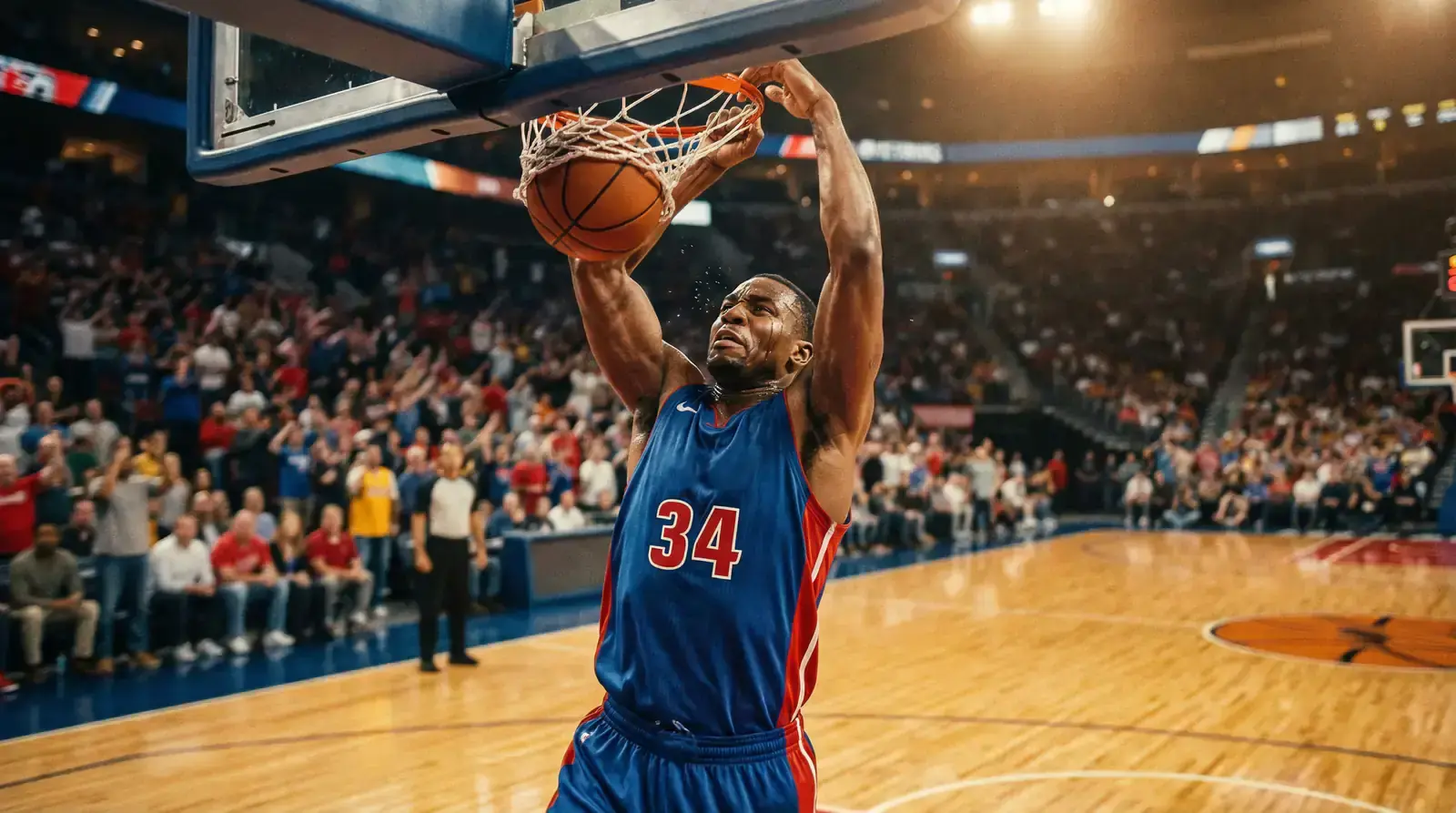
The game was a blowout. Celtics up by 25 with four minutes left, everyone checking their phones in the arena, garbage time in full swing. My mate thought his bets were toast – he had the Celtics spread, which was long dead. But I was focused on something else entirely: Jaylen Brown needed two more rebounds to hit the over on his 5.5 line. He grabbed one with three minutes left. Then another with ninety seconds remaining. The game was meaningless, but my NBA player props betting ticket cashed while the spread bettors walked away empty-handed.
That night crystallised something I had been noticing for years. Player props operate on a different wavelength than traditional game betting. The final score becomes almost irrelevant – what matters is individual performance within specific statistical categories. A player can have a terrible shooting night but still smash his rebounds over. A team can lose by thirty while their point guard cruises past his assists line because they spent the whole game playing catch-up.
For UK punters looking beyond spreads and totals, player props offer a refreshing alternative. You are no longer betting on outcomes influenced by twenty different players and countless variables – you are focusing your analysis on one person’s likely output in one statistical category. The discipline required is different, the research process is more targeted, and the edges available often fly under the radar of less specialised bettors. In my nine years analysing NBA betting markets, props have become an increasingly central part of my approach. This guide breaks down exactly how I evaluate them.
Top NBA Player Prop Betting Categories
Walk into any UK sportsbook’s NBA section and you will find player props organised by statistical category. Points props dominate – will LeBron score over or under 27.5 tonight? But the menu extends far beyond scoring, and understanding what is available shapes how you build your prop betting approach.
Points props are the most liquid and most analysed. Bookmakers set lines based on season averages, recent form, opponent defensive ratings, and expected pace. A scorer averaging 24 points per game might be lined at 23.5 against a stingy defence or 25.5 against a leaky one. The half-point matters enormously here – the difference between 24.5 and 25.5 can flip a bet from positive expected value to negative.
Rebounds props attract punters who understand that this category has lower variance than scoring. A centre averaging 10 rebounds rarely drops below 6 or exceeds 14. The outcomes cluster more predictably around the mean. Lines typically sit close to recent averages with modest adjustments for opponent rebounding tendencies. I find value here more consistently than in points markets precisely because public attention focuses elsewhere.
Assists props require understanding player roles and team systems. A primary ball handler on a motion offence will accumulate assists differently than one on an isolation-heavy team. Game script matters too – trailing teams often see their point guards rack up assists in catch-up mode, while leading teams might slow the pace and run clock.
Three-pointers made has become increasingly popular as the NBA’s shooting revolution continues. These props carry higher variance than other categories – a shooter might go 1-for-8 one night and 6-for-10 the next with similar shot quality. I approach threes made with caution and smaller stakes.
Steals and blocks – sometimes bundled as “stocks” – offer specialist opportunities. Defensive players with active hands can pile up steals against careless ball-handlers. Rim protectors feast on teams that attack the paint. But the sample sizes are small, the variance is high, and bookmakers often price these efficiently. I bet these sparingly and only with strong matchup conviction.
Turnovers, double-doubles, and first basket scorer round out the common prop menu. Each has its quirks. Turnovers reward betting unders on disciplined players against teams that do not force mistakes. Double-double props require both categories to hit simultaneously, which complicates the calculation. First basket is essentially a lottery ticket where tipoff tendencies and early offensive sets matter more than anything else.
Combination Props: PRA, Points + Rebounds, and More
I remember discovering PRA props – points plus rebounds plus assists combined into a single line – and thinking I had found a cheat code. A player could have an off shooting night but make up for it with extra rebounds and assists. The variance seemed lower, the outcomes more stable. Then I started tracking results and realised bookmakers had already figured this out. PRA lines are often the most efficiently priced props on the board.
PRA works by summing a player’s outputs across three categories into one total. A line of 35.5 PRA means you are betting whether the player will accumulate more or fewer than 35.5 combined points, rebounds, and assists. The appeal is diversification – weakness in one category can be offset by strength in another. The reality is that bookmakers price this accordingly, often leaving less value than in individual category props.
Points plus rebounds combinations target forwards and centres who contribute in both categories. These players often have more predictable floors because their rebounding provides a baseline even on poor shooting nights. A big man averaging 18 points and 10 rebounds might be lined at 27.5 points plus rebounds – he rarely falls below 20 combined even when shots are not falling.
Points plus assists combinations suit primary ball handlers who score and distribute. Guards running pick-and-roll offences often have strong correlations between these stats – when they are aggressive attacking, they either score or create for teammates. The categories move together more than they diverge.
Double-double props require hitting thresholds in two categories simultaneously – typically 10+ points and 10+ rebounds, or 10+ points and 10+ assists. The pricing here often looks attractive until you calculate the joint probability. A player might hit 10+ points 95% of games and 10+ rebounds 70% of games, but hitting both simultaneously is not 95% times 70%. Some games they exceed both comfortably; others they miss both narrowly. The correlation between categories matters enormously for double-double value assessment.
I generally prefer individual category props to combinations. When I identify an edge – say, a player likely to exceed his rebounds average against a weak rebounding team – I want to isolate that edge rather than dilute it across multiple categories. Combinations can mask sharp analysis with unnecessary noise.
How to Read Player Prop Lines
UK bookmakers present player props in a standardised format once you know what you are looking at. The player’s name appears first, followed by the statistical category, the line number, and the odds for over and under. Giannis Antetokounmpo – Points – Over 28.5 at 1.87, Under 28.5 at 1.95. That asymmetry in odds tells you something important.
When odds differ between over and under – 1.87 versus 1.95 in that example – the bookmaker is signalling where they expect action to flow or where they see the true probability sitting. Shorter odds on the over at 1.87 suggests the bookmaker thinks Giannis exceeding 28.5 is more likely, so they are offering worse value on that side. The under at 1.95 pays slightly better because it is assessed as less likely or because they need to attract money to balance their book.
Lines with equal odds on both sides – typically 1.90 or 1.91 each – indicate the bookmaker views the proposition as close to 50/50 after accounting for their margin. These are often the most efficiently priced lines where finding genuine value requires superior information or analysis.
The half-point on most lines eliminates ties. If the line is 28.5 and Giannis scores exactly 28, the under wins cleanly. Some books offer whole number lines with push rules – Giannis points at 28, where scoring exactly 28 returns stakes. These whole number lines typically carry higher juice on both sides to compensate for push probability.
Alternative lines appear alongside main lines at many bookmakers. You might see Giannis Over 25.5 at 1.50 and Over 31.5 at 2.50 bracketing the main 28.5 line. These alternatives let you adjust risk and reward – take a lower threshold for worse odds if you want higher probability, or reach for a higher threshold at better odds if you see blowout potential. The pricing of alternatives reveals how bookmakers model the probability distribution around their main line.
Line shopping across multiple UK bookmakers pays dividends for props. One book might have Giannis at 28.5 while another has 27.5 – that full point difference can flip a negative expectation bet to a positive one. I maintain accounts at several books specifically to capture these discrepancies.
Overtime and Player Props: What Counts?
The game went to double overtime. My player prop on Donovan Mitchell points sat at over 29.5 – he had 27 through regulation, looking dead in the water. Then overtime happened. Five extra minutes of basketball, Mitchell staying aggressive, and he finished with 34. The prop cashed not because of brilliant analysis but because overtime statistics counted.
Most player props at UK bookmakers include overtime by default. Points, rebounds, assists, threes made, steals, blocks – all count every second the player is on the court, regardless of whether that court time occurs in regulation or extra periods. This is standard practice and rarely varies between books, but checking specific terms before betting remains sensible.
The overtime inclusion creates strategic considerations. Players who stay on the court in close games – typically starters and key rotation pieces – benefit from extra opportunities when games extend. Role players who might be benched in overtime get no such boost. When evaluating a prop, I factor in both the likelihood of overtime and whether my player would remain in the game if it occurs.
Double-double and triple-double props also include overtime statistics. A player sitting at 9 rebounds entering the fourth quarter has additional runway if the game goes long. This matters for pricing – double-double probabilities increase slightly for players likely to see overtime minutes in projected close games.
The exception involves first half and quarter-specific props, which naturally exclude overtime since overtime cannot occur until after regulation. If you bet a first half points over, overtime is irrelevant – that bet settles at halftime regardless of what happens later.
Games projected as close – spread lines of 3 points or fewer – have higher overtime probability. I weight this when evaluating props for star players who will play 40+ minutes in tight games versus role players who might lose minutes as coaches tighten rotations.
Position-Specific Prop Betting Strategies
Guards and centres might as well be playing different sports when it comes to prop betting. A point guard covers five or more miles per game, constantly in motion, handling the ball on nearly every possession. A centre might cover half that distance, stationed in the paint, conserving energy for rebounding and rim protection. These workload differences create distinct fatigue patterns that smart prop bettors exploit.
Research consistently shows that back-to-back games affect team performance by 1 to 3 points on average – but that impact is not evenly distributed across positions. Guards show more pronounced fatigue effects than bigs. Their shooting percentages drop, their assist-to-turnover ratios worsen, and their overall production declines more steeply. When I see a primary ball handler on the second night of a back-to-back, I immediately look at unders on his points and assists props.
Centres and power forwards often maintain steadier production in fatigue spots. Rebounding requires positioning and effort but not the same explosiveness as perimeter play. A tired centre can still box out and grab boards. His points might suffer if his legs are not under him for post moves, but his rebounding floor remains relatively stable. I favour rebounds overs for bigs in back-to-back situations where points might disappoint.
Wing players fall somewhere between these extremes. Small forwards who function as secondary ball handlers show guard-like fatigue patterns. Those who primarily spot up and cut show more stability. Understanding a specific player’s role – not just his listed position – matters for predicting how fatigue will manifest.
Defensive matchups also vary by position. A guard facing an elite perimeter defender might see his points suppressed but his assists elevated as he passes out of pressure. A centre facing a rim protector might struggle to score inside but compensate with extra offensive rebounds on his misses. The statistical impact of a tough matchup is not always negative across all categories.
I build separate mental models for guards, wings, and bigs when evaluating props. The factors that matter, the variance profiles, and the fatigue patterns differ enough that treating all positions identically leads to suboptimal analysis.
Analysing Matchups for Player Props
Two weeks into the season, I had the Timberwolves’ Anthony Edwards over 26.5 points against a team I had not properly researched. He finished with 18. The opponent had the league’s best perimeter defence, funnelled everything to help, and made Edwards work for every look. That loss taught me that matchup analysis is not optional in prop betting – it is the foundation everything else rests on.
Defensive ratings by position reveal how opponents perform against specific player types. Some teams allow massive points to guards while shutting down bigs. Others pack the paint and dare perimeter players to shoot. These tendencies are relatively stable across games and highly predictive for individual props. A scorer averaging 24 points might be lined at 23.5 against a neutral defence, but that same line becomes attractive against a team allowing 28 points per game to his position and unattractive against one allowing 19.
Pace of play affects nearly every prop category. Fast-paced games create more possessions, more shots, more rebounds, more everything. A player who averages 22 points at league-average pace might project for 25 in a game with both teams running. Conversely, grind-it-out matchups between slow teams depress counting stats across the board. I adjust my expectations based on the projected pace, which I estimate from both teams’ season averages.
Game script considerations matter for assists especially. Teams trailing tend to push pace and create more assist opportunities as they try to catch up. Teams leading often slow down, run clock, and generate fewer assists in half-court sets. Research indicates that roughly 19% of games remain within 10 points entering the fourth quarter – those close contests play out differently than blowouts for stat accumulation purposes.
Individual defender assignments create matchup-specific edges. A scorer facing an All-Defensive team member plays under different constraints than one facing a poor defender. This information often is not fully priced into lines because bookmakers cannot track every defensive assignment. When I have conviction about a specific matchup – say, a quick guard attacking a slow-footed defender – I bet more aggressively than when matchups are neutral.
The key is layering these factors. A player in a fast-paced game against a weak positional defence with a favourable individual matchup represents a different proposition than one in a slow game against a strong defence shadowed by an elite stopper. Same player, same prop line, wildly different expected outcomes.
How Injuries Affect Player Prop Lines
The notification hit my phone at 4pm: star point guard ruled out for rest. I had been watching his backup’s prop lines all day, waiting for exactly this news. Within minutes, the backup’s points line jumped from 12.5 to 16.5 as bookmakers adjusted. Too late for sharp value – but I had already placed my bet at the original number.
Injuries to teammates create usage rate changes that ripple through prop markets. When a primary scorer sits, someone else takes those shots. When a playmaker is out, someone else handles the ball. These redistributions are predictable if you understand team hierarchies and playing styles. The backup point guard who suddenly starts will see elevated assists. The secondary scorer who moves into the primary role will see more shot attempts.
Bookmakers adjust lines quickly once injury news becomes official, but the window between rumour and confirmation often provides betting opportunities. Following beat reporters, monitoring shootaround reports, and checking injury updates throughout the day gives you access to information before it fully prices into markets. I have captured significant edges in the gap between “questionable” and “out” designations.
The magnitude of adjustment matters. Bookmakers sometimes overreact to star absences, boosting remaining players’ lines too aggressively. Other times they underreact, particularly for secondary effects like increased rebounds for role players when a primary rebounder sits. Understanding team dynamics helps you assess whether market adjustments are appropriate or exploitable.
Players returning from injury present the opposite situation. Lines often remain cautious – set at or below season averages – even when a player is fully healthy and likely to return to form. The first game back might indeed show rust, but by the second or third game, the “returning from injury” discount often becomes mispriced.
I maintain a watchlist of injury situations throughout the season. When a key player has been out for several games, I track how their teammates’ props have moved and prepare to bet the reverse adjustment when the injured player returns. These transitions create systematic mispricings that attentive bettors can exploit.
Research Process for Player Props
My prop betting workflow starts every morning at the same time. Coffee, laptop, and a systematic review of the night’s slate. No gut feeling bets, no chasing yesterday’s results – just process. The discipline took years to develop, but it transformed my results from break-even to consistently profitable.
First, I check injury reports across every team playing that night. Who is out? Who is questionable? Who played heavy minutes last night and might see reduced load today? This information shapes everything else. A secondary player with an elevated role due to injury becomes my primary focus.
Second, I pull recent form versus season averages. A player averaging 22 points for the season but 28 points over his last five games is performing above baseline. Is that sustainable or regression-bound? Context matters – maybe his recent opponents had weak defences, or maybe he has genuinely improved. I look at shot distribution, shooting percentages, and minutes to understand what is driving the divergence.
Third, I analyse tonight’s specific matchup. Opponent defensive rating by position. Pace projection based on both teams’ tendencies. Individual defender assignment if I can determine it. This is where the edge often lives – bookmakers set lines based on overall averages, but tonight’s specific context might deviate significantly from those averages.
Fourth, I compare my projection to the posted line. If I project a player for 25 points and the line is 22.5, that is potential value on the over. But I also check the odds – sometimes the line is lower because the juice is heavily skewed toward the over, which prices in the information I am using. Professional handicappers achieve roughly 47% success on spread picks even with sophisticated analysis; props are no easier. Finding genuine edges requires being right in ways the market has not already priced.
Fifth, I size my bets according to conviction. Strong edges with multiple supporting factors warrant larger stakes. Marginal edges or higher-variance categories warrant smaller stakes. No single bet risks more than a small percentage of my bankroll regardless of conviction – discipline protects against the inevitable losing runs.
This process takes an hour or more per night. Punters unwilling to invest that time should stick to simpler markets or accept that they are betting for entertainment rather than profit.
Building Your Player Props Strategy
Adam Silver once noted that the future of NBA consumption is about customisation – knowing your consumers and tailoring experiences to them. Player props embody that philosophy for bettors. Instead of betting on games as monolithic events, you are betting on individualised outcomes that align with your specific knowledge and analysis. The bettor who studies point guard assist patterns has a different edge than one who tracks centre rebounding matchups. Both can profit if they specialise effectively.
Start narrow rather than broad. Pick one statistical category and one player archetype – say, points props for volume scorers – and build expertise there before expanding. Track your bets religiously, noting not just wins and losses but why you made each selection and whether your reasoning held up. Patterns emerge over time that refine your approach.
Manage your bankroll with extra discipline in prop markets. The volume of available bets creates temptation to overextend. Every game offers dozens of props; a full slate offers hundreds. Selectivity matters more than volume. I would rather make three confident bets per night than ten marginal ones.
Combine prop betting with broader NBA understanding. The complete NBA betting guide covers game-level markets that complement prop analysis – understanding spreads and totals helps you contextualise the game environments where props will play out. A game projected to be high-scoring and close creates different prop dynamics than a likely blowout.
Finally, remember that props are a long game. Single-night results mean little given the variance involved. What matters is whether your process generates positive expected value over hundreds of bets. Trust your analysis, size appropriately, and let the maths compound over time. The punters who treat props as a craft rather than a gamble are the ones who build sustainable edges.
